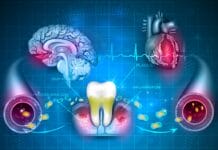


Maintaining good oral health is essential for overall systemic well-being, as it impacts an individual’s quality of life. A large body of research indicates that periodontal disease may be a risk factor for various systemic conditions, such as cardiovascular diseases, rheumatoid arthritis, cerebrovascular diseases, diabetes, obesity, preterm birth with low birth weight, and erectile dysfunction.1
A Cochrane review found moderate certainty of evidence that periodontal therapy can lower blood glucose levels in patients with diabetes compared to no treatment or usual care.2 It has also been found that periodontal therapy might enhance endothelial function, lower atherosclerosis biomarkers, and decrease inflammation, with non-responders to treatment showing a higher risk of cardiovascular disease.3

According to the World Health Organization, all healthcare providers need to recognize the association between oral and general health, emphasizing their role in diagnosing and referring patients to dental professionals. Specifically, medical practitioners (MPs) can promote oral hygiene among their patients by educating them on the importance of oral health. However, to do so effectively, they must first acquire a thorough understanding of oral health and its impact on overall health and then integrate this knowledge into their daily patient education practice.1
Because the levels of knowledge and practice regarding the association between oral and systemic health vary widely among MPs, there is a need to evaluate MPs’ knowledge and awareness in this area. This can help establish an educational and communication campaign and develop an integrated practice structure to prevent and effectively manage periodontal disease and its systemic consequences.1
A study aimed to assess the status of knowledge and practice of MPs concerning the association between periodontal disease and systemic conditions. Additionally, the study sought to assess the efficacy of a webinar as an interventional tool in enhancing knowledge and understanding amongst MPs.1
The Study
The study used a questionnaire to determine the knowledge and practice of MPs. The questionnaire was designed as a closed-ended survey covering the following areas:
- Demographic details, including age, sex, education level, specialties, years of practice, and email for follow-up regarding the upcoming educational webinar.
- Assessment of the MPs’ understanding of the association between periodontal disease and systemic conditions such as diabetes, obesity, cardiovascular disease, respiratory disorders, osteoarthritis, and systemic lupus erythematosus, as well as their knowledge of how periodontal treatment may affect preterm delivery and low birth weight.
- Evaluation of MPs’ practices, such as asking patients whether they’ve been diagnosed with periodontal disease, screening patients for periodontal disease, if they refer patients to a dentist for evaluation/care, and how confident they are performing a simple periodontal exam.1
After completing the original questionnaire, participants were sent a link to take a webinar on oral-systemic associations and the role periodontal disease plays in the overall health of patients. One month after the webinar, a second questionnaire was sent to the MPs who participated in the webinar to assess any knowledge gained through taking the webinar.1

The Results
The knowledge improved in all questions. For example, in the pre-webinar questionnaire, 63.64% of participants correctly identified that periodontal treatment influences the glucose level of patients with diabetes. This figure increased significantly to 90.91% in the post-webinar questionnaire. Before the webinar, 32% of MPs recognized periodontal disease as an independent risk factor for myocardial infarction, which significantly increased to 87.5% afterward.1
Notable improvements were also observed in participants’ knowledge of various topics:
- “Periodontal treatment aids in reducing systemic inflammatory markers,” increased from 61% to 87%.
- “Periodontal disease might lead to preterm delivery and low birth weight,” increased from 24% to 82%.
- “Periodontal disease might increase the risk of premature death,” increased from 22% to 80%.
- “Periodontal disease is a risk factor for rheumatoid arthritis and systemic lupus erythematosus,” increased from 32% to 75%.1
Additional significant increases in understanding were seen in awareness of the oral consequences of obesity and metabolic syndrome in children and adolescents (32% to 94%), the role of depression in increasing the risk of oral diseases (27% to 89%), the association of periodontal disease with renal failure (27% to 70%), and the role of periodontal disease in head and neck cancer development (34% to 65%).1
Among the 176 MPs surveyed, 89.77% reported having no training in medical school on periodontal disease or oral health. Before the webinar, 96 (54.55%) rated their knowledge of periodontal disease and its systemic associations as limited, with 63 (35.80%) rating it as moderate and 17 (9.66%) as good. After the webinar, these figures shifted significantly, with 36 (20.45%) rating their knowledge as limited, 88 (50.00%) as moderate, and 52 (29.55%) as good.1
Limitations
This study utilized a self-reported questionnaire, a method often criticized for inherent limitations such as inaccurate reporting and recall bias. Since this was a survey-based study, participation bias may have occurred, as those interested in the subject matter were more likely to respond. Further, the overall sample size was small despite multiple reminders sent to encourage broader participation.1
Another limitation was the insufficient time to observe changes in the MPs’ practices, meaning the responses may reflect an increase in knowledge rather than actual changes in behavior. Additionally, some participants might have had concerns about the webinar content, even though it was developed by two specialists, one in periodontology and one in oral medicine, based on the latest evidence regarding the relationship between periodontal disease and systemic conditions.1
Conclusion
The study revealed that medical professionals had limited to moderate knowledge and practice regarding the associations between periodontal disease and systemic health. Over 80% of respondents in the pre-webinar questionnaire indicated that they were uncomfortable performing a simple oral examination, had never asked patients about a periodontal disease diagnosis, and had not referred patients to a dentist for a periodontal evaluation.1
This lack of knowledge and practice likely leads MPs to prescribe antibiotics and pain medications for patients with dental pain at primary care centers instead of providing a referral for definitive dental care, which can contribute to issues like antibiotic resistance and opioid dependency. Therefore, MPs should routinely ask about oral health and take further action if there are signs of halitosis or oral infection. Ultimately, this study demonstrates that a targeted educational webinar is a highly effective tool for enhancing MPs’ oral-systemic knowledge and improving referral practices.1
Before you leave, check out the Today’s RDH self-study CE courses. All courses are peer-reviewed and non-sponsored to focus solely on high-quality education. Click here now.
Listen to the Today’s RDH Dental Hygiene Podcast Below:
References
- Parveen, S., Qahtani, A.S.A., Halboub, E., et al. Periodontal-Systemic Disease: A Study on Medical Practitioners’ Knowledge and Practice. Int Dent J. 2023; 73(6): 854-861. https://www.ncbi.nlm.nih.gov/pmc/articles/pmid/37330312/
- Simpson, T.C., Clarkson, J.E., Worthington, H.V., et al. Treatment for Periodontitis for Glycaemic Control in People With Diabetes Mellitus. Cochrane Database Syst Rev. 2022; 4(4): CD004714. https://www.ncbi.nlm.nih.gov/pmc/articles/PMC9009294/
- Holmlund, A., Lampa, E. Lind, L. Poor Response to Periodontal Treatment may Predict Future Cardiovascular Disease. J Dent Res. 2017; 96(7); 768-773. https://pubmed.ncbi.nlm.nih.gov/28363032/