

Are you in need of CE credits? If so, check out our peer-reviewed, self-study CE courses here.
Test Your Glossitis Knowledge
1. Which of the following signs or symptoms is characteristic of glossitis?
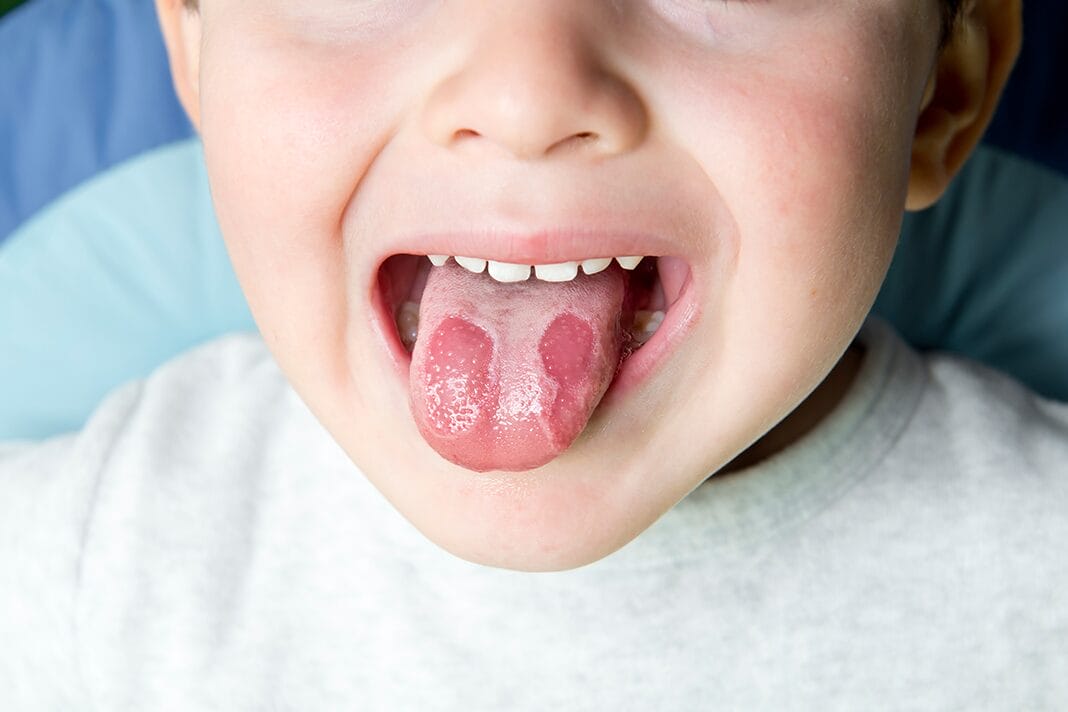
Glossitis is the term used to describe inflammation of the tongue. Clinically, it may present as a change in the surface appearance (texture and/or color) of the tongue. Other common signs and symptoms include pain, erythema, inflammation, and depapillated areas.1
Types of glossitis and their oral manifestations include:
- Atrophic glossitis: Smooth, shiny dry appearance due to the lack of lingual papillae, which may be erythematous.
- Median rhomboid glossitis: Central rhomboid-shaped hyperkeratotic areas that typically appear as erythematous plaque-like lesions on the central dorsum of the tongue, which may be tender to palpation.
- Benign migratory glossitis (geographic tongue): Areas of papillae loss that may be surrounded by a white border that can change position (migrate) over time and may be sensitive to touch or specific foods.
- Geometric glossitis: Painful linear fissures throughout the mobile tongue.
- Strawberry tongue: Red, denuded appearance on the tongue's dorsum with persistent hypertrophic fungiform papillae.1
Reference
1. Sharabi, A.F., Winters, R. Glossitis. (2023, August 8). StatPearls. https://www.ncbi.nlm.nih.gov/books/NBK560627/
2. Glossitis is caused exclusively by vitamin B deficiencies.
While vitamin B deficiencies can be a cause, glossitis has numerous potential etiologies. These can be broadly categorized, with common examples including:
- Nutrient deficiencies: Vitamin B (B1, B2, B3, B6, B9, and B12), vitamin E, iron, and zinc1,2
- Anemia: Iron-deficiency and pernicious
- Infections: Viral, bacterial, fungal, and parasitic
- Medications: ACE inhibitors, albuterol, oral contraceptives, organosulfur antimicrobial drugs, and lithium carbonate
- Other contributing factors: Exposure to irritants, mechanical trauma, psychological factors, familial variants, autoimmune conditions, burning mouth syndrome, Down syndrome, and poor hydration2
References
1. Chiang, C.P., Chang, J.Y., Wang, Y.P., et al. Atrophic Glossitis: Etiology, Serum Autoantibodies, Anemia, Hematinic Deficiencies, Hyperhomocysteinemia, and Management. J Formos Med Assoc. 2020; 119(4): 774-780. https://www.sciencedirect.com/science/article/pii/S0929664619303481
2. Sharabi, A.F., Winters, R. Glossitis. (2023, August 8). StatPearls. https://www.ncbi.nlm.nih.gov/books/NBK560627/
3. Which type of glossitis is most often seen in bacterial toxin-mediated infections?
Strawberry tongue is most often seen in bacterial toxin-mediated infections, such as scarlet fever. The bacterial toxins act as superantigens, inducing nonspecific polyclonal immune cell activation and the massive release of inflammatory mediators, which are responsible for the morphological changes in the tongue's appearance.1
The "strawberry" appearance is characterized by the desquamation (shedding) of the keratinized epithelium of the filiform papillae. This leaves a red, denuded surface where the fungiform papillae remain persistently hypertrophic (enlarged) and inflamed, resembling the "seeds" of a strawberry.1
While scarlet fever is most commonly associated with strawberry tongue, it is also seen in other conditions, including:
- Bacterial toxin-mediated infections: Scarlet fever, group A streptococcal pharyngitis, toxic shock syndrome, recurrent toxin-mediated perianal erythema, recalcitrant erythematous desquamating disorder, and Yersinia pseudotuberculosis
- Viral infections: Yellow fever
- Non-infectious conditions: Kawasaki disease1
Reference
1. Adya, K.A., Inamadar, A.C., Palit, A. The Strawberry Tongue: What, How and Where?. Indian J Dermatol Venereol Leprol. 2018; 84(4): 500-505. https://ijdvl.com/the-strawberry-tongue-what-how-and-where/
4. Fewer than 10 medications from only 4 drug classes are known to cause drug-induced glossitis.
Numerous medications from various drug classes can cause glossitis. An analysis of the national drug information database for Dutch pharmacists found that 121 of the 1645 drugs reviewed were associated with adverse reactions affecting the tongue. Of those, 36 medications were identified as being associated with glossitis.1
Examples of drug classes and medications associated with glossitis as an adverse reaction include:
- Antibiotics: Tetracycline, minocycline, doxycycline, benzylpenicillin, tobramycin, clarithromycin, ceftriaxone, linezolid, daptomycin, imipenem/cilastatin, sulfanilamide, and sulphathiazole
- Antihypertensives: Captopril, enalapril, ramipril, quinapril, and betaxolol
- Bronchodilators: Fenoterol, tiotropium bromide, and albuterol1,2
- Antineoplastic agents: Tivozanib and methotrexate
- Analgesics: Diclofenac
- Bisphosphonates: Risedronic acid
- Anticonvulsants: Carbamazepine1
References
1. Aziz, Y., Rademacher, W.M.H., Hielema, A., et al. Oral Adverse Effects: Drug-Induced Tongue Disorders. Oral Dis. 2021; 27(6): 1528-1541. https://pmc.ncbi.nlm.nih.gov/articles/PMC8451755/
2. Sharabi, A.F., Winters, R. Glossitis. (2023, August 8). StatPearls. https://www.ncbi.nlm.nih.gov/books/NBK560627/
5. Atrophic glossitis can be caused by iron-deficiency anemia and pernicious anemia. Symptoms of atrophic glossitis rarely occur.
Both iron-deficiency anemia and pernicious anemia can cause atrophic glossitis.1
The cause of iron deficiency anemia varies and may result from insufficient iron intake, decreased iron absorption (i.e., celiac disease), increased iron demand (i.e., pregnancy), or blood loss.2 Pernicious anemia is a complex, rare autoimmune disorder that causes vitamin B12 deficiency secondary to intrinsic factor (IF) deficiency due to the production of anti-intrinsic factor antibodies. These antibodies inhibit B12 from binding to IF, leading to impaired B12 absorption in the intestines.3
Characterized by the partial or complete loss of primarily filiform papillae and, to a lesser extent, the fungiform papillae, atrophic glossitis causes pain, burning sensations, paresthesia, and taste dysfunction in a high proportion of patients:
- Loss of protection: The loss of filiform papillae and their layer of keratinized stratified squamous epithelium leaves the underlying nerves and connective tissue unprotected. Without this barrier, the tongue is vulnerable to chemical, mechanical, and physical stimuli, which can result in pain, burning sensations, or paresthesia.
- Loss of taste: Because the fungiform papillae contain taste cells, their atrophy can lead to taste dysfunction, such as hypogeusia (reduced taste) or ageusia (loss of taste).1
References
1. Chiang, C.P., Chang, J.Y., Wang, Y.P., et al. Atrophic Glossitis: Etiology, Serum Autoantibodies, Anemia, Hematinic Deficiencies, Hyperhomocysteinemia, and Management. J Formos Med Assoc. 2020; 119(4): 774-780. https://www.sciencedirect.com/science/article/pii/S0929664619303481
2. Warner, M.J., Kamran, M.T. Iron Deficiency Anemia. (2023, August 7). StatPearls. https://www.ncbi.nlm.nih.gov/books/NBK448065/
3. Vaqar, S., Shackelford, K.B. Pernicious Anemia. (2023, May 8). StatPearls. https://www.ncbi.nlm.nih.gov/books/NBK540989/