
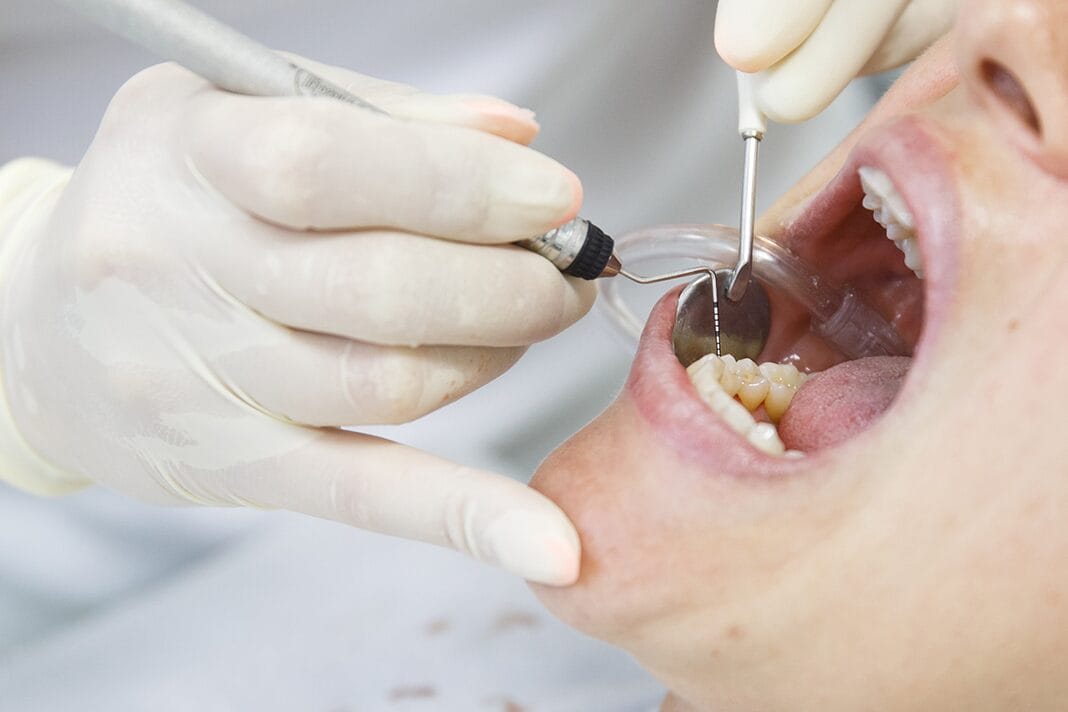
A comprehensive periodontal examination is a fundamental component of the overall clinical assessment, as the profession itself is defined in part by the prevention and management of periodontal disease. Just as an oral cancer exam is not reserved for only those with suspicious lesions, periodontal examinations are a necessity for all patients, regardless of signs and symptoms.
The American Academy of Periodontology (AAP) recommends that patients receive a comprehensive periodontal examination at least annually.1 It includes collecting and documenting:

-
- Probing depths
- Bleeding on probing
- Suppuration
- Clinical attachment levels
- Mucogingival involvement (width of attached gingiva)
- Furcation involvement
- Mobility and fremitus
- Tooth loss
- Biofilm and calculus deposits
- Gingival tissue changes (color, size, shape, surface texture, position)
- Radiographic evaluation of bone height/loss
- Risk factors such as smoking, diabetes, and A1c2,3
While a comprehensive examination involves multiple components, the data gathered from periodontal probing and charting contribute to determining periodontal status, serving as a basis for the dental hygiene diagnosis (periodontal classification) and treatment plan.2,4,5
Periodontal Probing Technique
Accurate periodontal charting relies on proper technique, and the manual probe remains the instrument of choice for assessing tissue health and diagnosing periodontal disease. However, inadequate probing techniques may lead to errors in gathering data. For example, excessive force has been shown to artificially increase probing depth measurements, undermining reproducibility and making it challenging to compare with future periodontal examinations.4,6
There are several generations of periodontal probes, with the second generation and forward designed to improve reproducibility through force (pressure) control. Nonetheless, the first-generation manual probe is considered the “gold standard,” with multiple options that include different markings, most commonly 1 mm, 3 mm, or a combination of increments. Research suggests that probes with markings in 1 mm increments may provide more accurate measurements because rounding errors are minimized when probe depths fall between markings. When the gingival margin (GM) does fall between markings, round up to the nearest whole millimeter for the final measurement.4
No matter your preferred probe, markings and color coding should be easy to read to maintain accuracy. Using the same type of probe consistently also results in greater measurement reliability.4
Because the sulcus/pocket is continuous around the tooth, spot probing is inadequate for a thorough assessment. The limited information gathered cannot accurately provide a periodontal classification, which can impede proper treatment planning. Instead, a thorough examination requires a continuous walking stroke around the entire circumference of the tooth to ensure the deepest points are identified and recorded across 6 sites.4
To perform this, gently insert the probe into the sulcus/pocket, keeping it parallel to the tooth’s long axis and maintaining light pressure until mild resistance from the epithelial attachment is felt. Rather than repeatedly removing and reinserting – which can cause unnecessary tissue trauma – the probe is moved in 1 to 2 mm up-and-down strokes as it advances in 1 mm increments around the tooth.4
Interproximal probing requires angulation adjustments to account for tooth anatomy, as errors are a recognized source of inaccurate measurements. When moving from the line angle toward the contact point, the probe should touch the contact area and be slanted toward the midline of the col – the depression just below the contact point. To ensure full coverage of the proximal area, strokes from the facial/buccal surface should overlap with those from the lingual/palatal surface.4
Pressure or force is also recognized as a source of error that can significantly influence probing depth measurements. Pressure must remain light (approximately 0.20 g) to avoid inaccuracies, as excessive force has been shown to nearly double measurements.4,6
Bleeding on Probing
Bleeding on probing (BOP) is an indicator for distinguishing between gingival health and disease.3,4,7,8 The definition of health is less than 10% BOP, whereas scores 10% or more indicate gingivitis. Specifically, localized gingivitis is defined as 10% to 30% bleeding sites, and generalized gingivitis is defined as more than 30%.8
To ensure that scores reflect inflammation rather than tissue trauma, avoid excessive pressure as BOP has an almost linear association with the forces applied during probing.6 It is also recommended to wait 30 seconds before assessing bleeding, especially in tissue that appears to be healthy.8,9
Clinical Attachment Level
Clinical attachment level (CAL) is the position of the periodontal attached tissues at the base of a sulcus/pocket. While probing depth is measured from the changeable GM, CAL is measured from a fixed point – the cementoenamel junction (CEJ) – unless abrasion or a restoration makes it undetectable. The GM is typically positioned 1 to 2 mm coronal to the CEJ. Stability of this level is a characteristic of health, while a loss of attachment is a primary feature of periodontitis.4
To calculate CAL, first identify the position of the GM:
-
- GM at the CEJ: The probing depth and CAL are equal.
- Gingival recession: Add the distance between the CEJ and the GM to the probing depth (PD + GM = CAL).
- GM covers the CEJ: Subtract the distance from the CEJ to the GM from the total probing depth (PD – GM = CAL).4
Biofilm and Calculus Deposits
Biofilm and calculus detection typically includes a combination of visual inspection and tactile exploration.4,10
Biofilm may be translucent and difficult to identify with direct vision unless it is thick or stained. It can be detected by passing the side of a probe or explorer over the tooth surface to physically disrupt the deposit. However, applying a disclosing agent is the most effective for direct visualization and a thorough assessment.10
Documentation of biofilm should include the location and thickness (slight, moderate, or heavy) to track changes throughout treatment and follow-up appointments.10
Calculus is classified by its location relative to the gingival margin: supragingival or subgingival.4,10 Supragingival deposits may be identified directly or indirectly using a mouth mirror, though small deposits may only become visible when dried with compressed air. The edges of dark-colored subgingival calculus may be visible when located at or just below the GM and could be better seen with a gentle blast of air to deflect the tissue. A visible shadow along the gingiva may also indicate the presence of dark-colored subgingival calculus.10 Although large interproximal deposits may be visible on radiographs, radiographic review has limited value for comprehensive calculus detection.4,10
Instead, the detection of subgingival calculus deposits requires tactile examination. While a rough surface may be felt during probing, an explorer such as an ODU 11/12 should be used to thoroughly examine each tooth to the base of the sulcus/pocket to detect subgingival deposits.10
Documentation of calculus deposits should include the location (e.g., supragingival or subgingival), distribution (e.g., localized or generalized), and amount (slight, moderate, or heavy).4,10
Furcation Involvement
The presence of furcation involvement indicates that clinical attachment level and bone loss have extended into the area between the roots (interradicular) of a multirooted tooth, increasing the risk of tooth loss.3
Following radiographic review to identify interradicular radiolucencies (sometimes called a furcation arrow), clinicians should use a furcation probe such as a Nabers 1N or 2N to identify the furcation entrance and extent.3,4 To assess these areas accurately, adaptation of a probe to the specific morphology of the tooth is necessary:
-
- Bifurcated teeth: Mandibular molars (accessed from buccal and lingual) and maxillary first premolars (accessed from mesial and distal, under the contact area)
- Trifurcated teeth: Maxillary molars (accessed from the buccal, mesiolingual, and distolingual surfaces)4
Furcation involvement is commonly categorized based on the amount of bone loss in the furcation area using Glickman furcation grades:
-
- Grade I: Early, beginning involvement. The probe can enter the furcation concavity, but the interradicular bone remains intact.
- Grade II: Moderate involvement. The probe enters the furcation but does not pass completely through to the opposite side.
- Grade III: Severe, through-and-through involvement. The probe passes completely between the roots, but the furcation remains covered by soft tissue.
- Grade IV: Same as grade III, but the furcation is clinically visible due to gingival recession.3,4
Tooth Mobility
Tooth mobility can be differentiated as normal (physiologic) or abnormal (pathologic). All teeth with a periodontal ligament have some physiologic mobility. No mobility only occurs when the periodontal ligament is absent, such as in ankylosis. In contrast, pathologic mobility that exceeds normal can indicate underlying issues, such as disease progression or occlusal trauma.4
Although limited by subjective interpretation, the most accurate clinical method to evaluate mobility involves applying pressure to the tooth using two metal instruments with wide, blunt ends held with a modified pen grasp. Applying specific, firm fulcrums helps ensure standardized pressure, contributing to increased consistency across determinations. The use of wooden tongue depressors, plastic instrument handles, or fingertips is discouraged because their flexibility or soft tissue displacement can give the illusion of excessive tooth mobility.4
To determine mobility, stabilize the patient’s head to prevent movement of the head, lips, or cheeks from interfering with the assessment:
-
- Horizontal mobility: Apply alternating, light pressure to the buccolingual surfaces using the blunt ends of the instruments.
- Vertical mobility: Apply pressure to the occlusal or incisal surface using one blunt end of an instrument to check for depression of the tooth within its socket.4
Mobility is typically categorized based on the degree of displacement using the Miller Index:
-
- N (normal): Normal, physiological mobility
- Grade 1: Slight pathological mobility, greater than normal
- Grade 2: Moderate mobility, greater than 1 mm of horizontal displacement
- Grade 3: Severe mobility, moves vertically and is depressible within the socket4
In Closing
A comprehensive periodontal examination contributes to determining a dental hygiene diagnosis, a fundamental part of the process of care. It involves assessing multiple components, including data gathered from periodontal probing and charting, to determine treatment needs within the scope of dental hygiene practice.2,5
It is important to remember that periodontal “health” is a definitive dental hygiene diagnosis in its own right.3,8 Regardless of the findings, every patient should leave the chair with a clear understanding of their periodontal status and treatment plan, whether that involves therapeutic or preventative intervention.2
Although time constraints remain a constant pressure in clinical practice, accurately gathering and documenting assessment data helps ensure optimal care and supports improved systemic and oral health outcomes.2
Before you leave, check out the Today’s RDH self-study CE courses. All courses are peer-reviewed and non-sponsored to focus solely on high-quality education. Click here now.
Listen to the Today’s RDH Dental Hygiene Podcast Below:
References
- American Academy of Periodontology. Comprehensive Periodontal Therapy: A Statement by the American Academy of Periodontology. J Periodontol. 2011; 82(7): 943-949. https://aap.onlinelibrary.wiley.com/doi/10.1902/jop.2011.117001
- Standards for Clinical Dental Hygiene Practice Committee. (2025, March). Standards for Clinical Dental Hygiene Practice. American Dental Hygienists’ Association. https://www.adha.org/wp-content/uploads/2025/03/2025_Standards-of-Dental-Hygiene-Practice.pdf
- Boyd, L. D., & Wilkins, E. M. (2023). Periodontal Disease Development. In L. D. Boyd & L. F. Mallonee, Wilkins’ Clinical Practice of the Dental Hygienist (14th ed., pp. 343-364), Jones and Bartlett Learning.
- Boyd, L. D., & Wilkins, E. M. (2023). Periodontal Examination. In L. D. Boyd & L. F. Mallonee, Wilkins’ Clinical Practice of the Dental Hygienist (14th ed., pp 365-387). Jones and Bartlett Learning.
- Boyd, L. D., & Ranson, C. G. (2023). Dental Hygiene Diagnosis. In L. D. Boyd & L. F. Mallonee, Wilkins’ Clinical Practice of the Dental Hygienist (14th ed., pp. 415-424). Jones and Bartlett Learning.
- Diagnosis and Examination. (n.d.) American Academy of Periodontology. https://www.perio.org/research-science/periodontal-literature-review/diagnosis-and-examination/
- Boyd, L. D., & Wilkins, E. M. (2023). The Periodontium. In L. D. Boyd & L. F. Mallonee, Wilkins’ Clinical Practice of the Dental Hygienist (14th ed., pp. 327-342). Jones and Bartlett Learning.
- Chapple, I.L.C., Mealey, B.L., Van Dyke, T.E., et al. Periodontal Health and Gingival Diseases and Conditions on an Intact and a Reduced Periodontium: Consensus Report of Workgroup 1 of the 2017 World Workshop on the Classification of Periodontal and Peri-Implant Diseases and Conditions. J Periodontol. 2018; 89 Suppl 1: S74-S84. https://aap.onlinelibrary.wiley.com/doi/10.1002/JPER.17-0719
- Mallonee, L. F., & Wyche, C. J. (2023). Indices and Scoring Methods. In L. D. Boyd & L. F. Mallonee, Wilkins’ Clinical Practice of the Dental Hygienist (14th ed., pp. 387-414). Jones and Bartlett Learning.
- McConnell, C. A., & Boyd, L. D. (2023). Dental Soft Deposits, Biofilm, Calculus, and Stain. In L. D. Boyd & L. F. Mallonee, Wilkins’ Clinical Practice of the Dental Hygienist (14th ed., pp. 273-300). Jones & Bartlett Learning.