
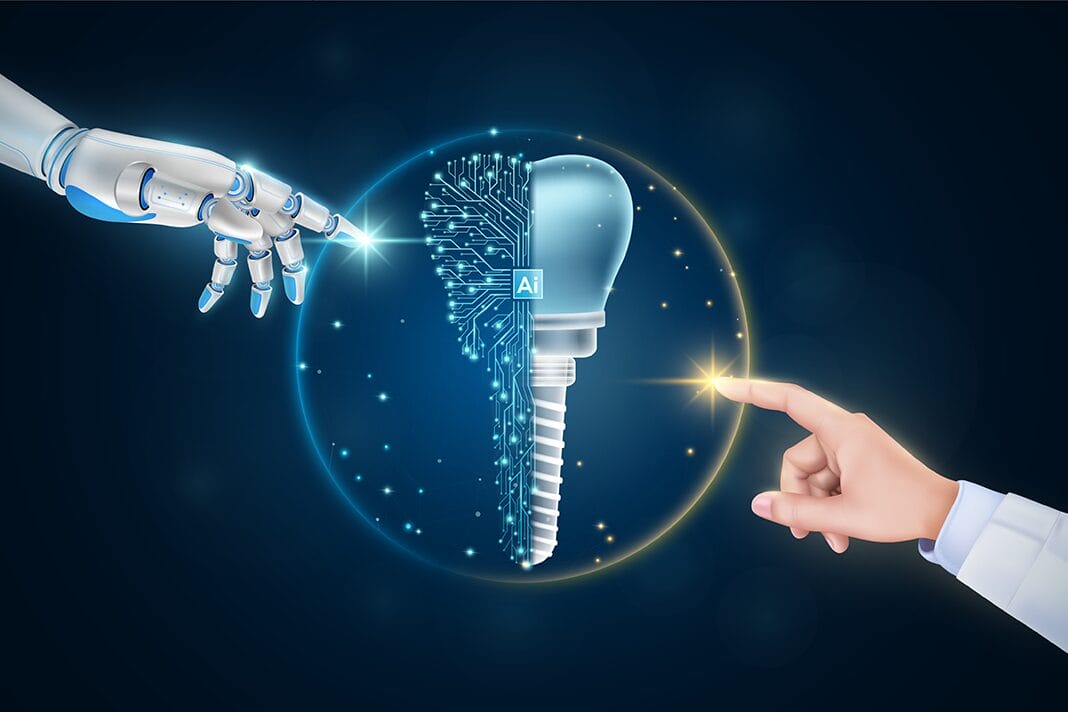
A growing concept that most seem to be equally fascinated by and nervous about is artificial intelligence (AI). AI raises a plethora of nerve-wracking questions for many. Will it eventually outsmart humans? Will most of our jobs become obsolete? Can AI develop its own consciousness? Are we in the Matrix?!
While these fears are mostly founded, AI’s benefits and wonderful advancements in health care are worth noting and celebrating. The world of dental hygiene is changing, as is the rest of the medical world, and hygienists should understand the tools available that could potentially help enhance their quality of care. The integration of AI in dentistry is slowly beginning to occur and is infiltrating many aspects, including diagnostics, treatment planning, and patient education.
When you’re running late with each patient, it can be daunting to quickly skim their radiographs for signs of new calculus, potential periodontal bone loss, caries development, or other dental pathologies. If you have experienced that overwhelming feeling, this AI technology is for you.
Periodontal Pathologies
Gone are the days of filtering through a patient’s previous radiographs, trying to recognize minimal changes with the naked eye. AI has the ability to not only detect radiographic calculus and highlight it for you on the radiograph but also accurately measure periodontal bone levels, detect widened PDLs, and compare them to previous radiographs in an instant.1,2
AI is able to quickly and thoroughly calculate all these aspects (and more) in just a few moments. This allows a hygienist to easily evaluate radiographic information and be more equipped to provide early intervention, necessary treatment, and education for their patients.1
Implementing AI can also help reduce the likelihood of measurement and diagnostic inaccuracies caused by clinician fatigue, time constraints, or limited experience.1,2
Endodontic Pathologies
AI systems are currently used in endodontics, and studies have shown an exceptional treatment accuracy of 96%, which is higher than that of professional endodontists without AI. Similarly, AI has been shown to help endodontists achieve 96.6% accuracy in diagnosing vertical root fractures, typically using CBCT images and panoramic radiographs.3
Maxillofacial Pathologies
One example of how AI can be used in oral surgery is by predicting postoperative facial swelling after teeth extraction. Studies show that AI is delivering excellent results, which could be a game-changer for oral surgeons, enabling them to predict the prognosis of potential treatments better.3
Caries/Enamel Pathologies
The detection of early caries can be difficult to assess and is often dependent on clinical skill and opinion. Although none of the existing dental imaging systems can differentiate active from arrested caries, with the implementation of AI, baseline decay can be highlighted and the percentage of demineralization quantified. AI can also assess trends and patterns to build a more complete picture of the patient’s history and potential future susceptibilities, rather than treating the matter solely as a current issue.1
Having this AI-based tool can help the hygienist accurately prepare the patient for what the dentist may need to evaluate during the exam for possible treatment. This allows for more fluid communication between providers and patients, which can often lead to a higher level of treatment acceptance.
Patient Education
In my personal career as a hygienist, I’ve often extensively searched YouTube or Google Images to find a visual representation of the concept I’m trying to explain to my patient. I’m happy to say that AI can make that tedious process much easier. AI can quickly generate informative and easily understandable educational materials, including videos, articles, and interactive presentations.
What’s more, this AI-generated content can be individualized to each patient’s specific needs and preferences, creating a personalized experience. This allows patients to make better-informed decisions about their oral health and also helps encourage compliance with treatment recommendations.2
Another great option AI offers is interactive chatbots, which are able to engage with patients in real time. They can answer patients’ questions, provide information, and guide them through various aspects of pre- and post-treatment. This option can reduce the staff burden and help increase availability for patients during closing hours, thus promoting overall health for all involved.2
Oral Cancer Diagnosis
AI tools are able to detect signs of oral cancer much earlier than previously possible by analyzing images of oral lesions, such as tissue discolorations or irregularities. Being able to discover such signs of oral cancer early as a clinician can often be difficult due to limited visibility or individual clinical skill.4
By detecting these pathologies early, the patient has a higher chance of successful treatment outcomes. Using an AI-based oral cancer screening tool is an incredibly valuable addition to routine dental exams, providing an extra layer of vigilance that patients appreciate.4
In Closing
Can artificial intelligence be intimidating? Absolutely! That said, if you and your dental office are not at least considering implementing some of these modern trends, it may be wise to consider the many benefits for both patients and clinicians.
While a clinician is able to use skill sets, education, and experience to properly diagnose and treat oral conditions, utilizing AI technology is a hugely beneficial complement to providers in their decision-making process.3 AI is a tool that can assist and enhance the patient care a dental professional provides, not be seen as a replacement for it.5,6
A broader AI movement exists, whether we are ready or not to embrace it, and dental hygienists are encouraged to stay updated on these developments, as the capabilities of dental AI could have tremendous potential.
Before you leave, check out the Today’s RDH self-study CE courses. All courses are peer-reviewed and non-sponsored to focus solely on high-quality education. Click here now.
Listen to the Today’s RDH Dental Hygiene Podcast Below:
References
- Dentistry – Overview of Artificial and Augmented Intelligence Uses in Dentistry [ADA SCDI White Paper No. 1106]. (2022, December 30). American Dental Association. https://www.ada.org/-/media/project/ada-organization/ada/ada-org/files/resources/practice/dental-standards/ada_1106_2022.pdf
- Mahesh Batra, A., Reche, A. A New Era of Dental Care: Harnessing Artificial Intelligence for Better Diagnosis and Treatment. Cureus. 2023; 15(11): e49319. https://www.ncbi.nlm.nih.gov/pmc/articles/PMC10748804/
- Khanagar, S.B., Al-Ehaideb, A., Maganur, P.C., et al. Developments, Application, and Performance of Artificial Intelligence in Dentistry – A Systematic Review. Journal of Dental Sciences. 2021; 16(1): 508-522. https://www.ncbi.nlm.nih.gov/pmc/articles/PMC7770297/
- García-Pola, M., Pons-Fuster, E., Suárez-Fernández, C., et al. Role of Artificial Intelligence in the Early Diagnosis of Oral Cancer. A Scoping Review. Cancers. 2021; 13(18): 4600. https://www.ncbi.nlm.nih.gov/pmc/articles/PMC8467703/
- Cholan, P., Ramachandran, L., Umesh, S.G. et al. The Impetus of Artificial Intelligence on Periodontal Diagnosis: A Brief Synopsis. Cureus. 2023; 15(8): e43583. https://www.ncbi.nlm.nih.gov/pmc/articles/PMC10503663/
- Bonny, T., Al Nassan, W., Obaideen, K., et al. Contemporary Role and Applications of Artificial Intelligence in Dentistry. F1000Research. 2023; 12: 1179. https://www.ncbi.nlm.nih.gov/pmc/articles/PMC10630586/