

When my son was about 3 years old, he started having severe pain in his hip to the point that he refused to walk or put any pressure on it. As you can imagine, this was very distressing. After multiple doctor’s visits, radiographs, and a referral to a specialist, he was diagnosed with transient synovitis of the hip. Transient synovitis of the hip is a self-limiting joint condition of unknown etiology. While its onset can be sudden, the pain often begins mildly and gradually worsens over a few days.1
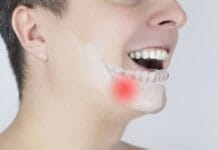
The sudden or gradual onset of unexplained joint pain that can hinder mobility is an alarming experience. Though transient synovitis does not occur in areas of the body that dental professionals typically manage, a similar condition, synovial chondromatosis (SC), can affect the temporomandibular joint (TMJ), leading to pain and limited range of motion.2
An Overview of Synovial Chondromatosis
SC is a rare condition affecting the synovial membrane of joints. It is characterized by loose cartilaginous bodies arising from metaplastic changes within the synovium. While the condition can occasionally be self-limiting, it typically presents with swelling and pain, and may lead to severe disability, dysfunction, and destruction of the affected joint. Although SC is mostly benign, in rare cases, it can undergo malignant transformation into chondrosarcoma.2
Most commonly occurring in the fifth decade of life, SC is seldom seen before age 20 and is exceptionally rare in children. There are two forms of SC: primary and secondary. Primary SC presents with no evidence of concurrent joint pathology, while secondary SC occurs alongside joint degeneration.2
SC primarily affects large synovial joints, such as the elbow, knee, wrist, and hip, with only about 3% of cases occurring in the TMJ (TMJ-SC). Though TMJ-SC is considered rare, its incidence has increased in recent years, likely due to improved diagnosis associated with the increased use of cone beam computed tomography (CBCT) imaging in dentistry.3 Men are affected more often than women in most large joints, with the exception of the TMJ.3,4 TMJ-SC is more common in women, with a prevalence similar to that of general temporomandibular disorders (TMDs), which may be related to estrogen’s effect on the TMJ.3-5
When SC lesions occur in the TMJ, they are usually unilateral and limited to the upper joint compartment, possibly due to the smaller size of the synovial membrane and the more narrow nature of the lower compartment.3 Signs and symptoms are nonspecific and include limited mouth opening, pain, preauricular swelling, malocclusion, and crepitus or clicking during mouth opening.3,5 While the condition can occasionally be self-limiting in other joints, TMJ-SC does not spontaneously resolve.3
Disease Progression and Diagnosis
SC progresses through three histological stages, known as the Milgram classification, based on disease activity and development:
- Stage I: This early stage involves active synovial metaplasia, without formation of loose bodies.2-5 It may be asymptomatic or present with localized pain and inflammation.2
- Stage II: Considered a transitional stage, active synovial metaplasia is present, and cartilaginous nodules enlarge or are released, becoming loose bodies.2-5 Mechanical symptoms such as joint locking or catching and reduced range of motion may occur.2
- Stage III: Active metaplasia has stopped, but multiple loose bodies fill the joint space.2-5 This stage is often asymptomatic.2
TMJ-SC can be challenging to distinguish from other conditions and is often misdiagnosed as TMD or arthritis due to nonspecific symptoms. Additionally, the average time for symptom onset is over 1 year, contributing to the delayed diagnosis.4,5 Early diagnosis is further difficult, particularly in Milgram stage I (active metaplasia), because cartilage formation is confined to the synovium and calcification has not yet begun. In this stage, conventional radiographic imaging, computed tomography (CT), or CBCT may show only a normal or widened joint space.3
In stage II, when calcification is absent or poor, findings may appear the same as stage I, though bone changes of the glenoid fossa and condyle may begin to appear. Calcified loose bodies are the most valuable diagnostic sign and can be detected in later stage II and stage III.3,5 Over 80% of patients are diagnosed at Milgram stage III.4
Because conventional radiographs, CT, and CBCT are limited in their ability to visualize uncalcified cartilaginous nodules, magnetic resonance imaging (MRI) could help provide an earlier diagnosis. MRI can detect uncalcified nodules and visualize soft tissue changes, such as an expanded joint capsule, synovial thickening, and joint effusion, that are radiographically invisible.3,5 For TMJ-SC, MRI is considered a reliable diagnostic tool, with an estimated diagnostic accuracy of approximately 96%.3
While imaging is often sufficient for a primary diagnosis, arthroscopy can also be a valuable tool for direct visualization when imaging is inconclusive, allowing clinicians to find specific features of SC within the joint.3,5 However, a definitive diagnosis can only be made by a histological examination of the loose bodies or synovial membrane.4,5
Treatment and Management
Because TMJ-SC cannot spontaneously resolve and does not respond to conservative management, surgical intervention is the only effective treatment.3 Surgical approaches include arthroscopy, open surgery, or a combination of both. The primary goals are the removal of all loose bodies and the affected synovium (synovectomy).3,4
Arthroscopy is a less invasive option with a wide field of view that can detect hard-to-find lesions in cases where loose bodies are less than 3 mm and limited to a single joint compartment. However, arthroscopy may be insufficient for the complete removal of all loose bodies and the abnormal synovial membrane.3
Open surgery allows for the effective removal of all loose bodies and the synovial membrane, making it the treatment of choice.3,4 Because the fossa can be difficult to visualize during open surgery, a condyle osteotomy or zygomatic arch amputation may be performed to improve access.3 Depending on the extent of joint involvement, an articular disc resection or, less frequently, a condylar resection may also be required.4
Combining open surgery with arthroscopy is a beneficial technique because it allows for the complete elimination of lesions with minimal osteotomy and reduced surgical time.3,4
Although the recurrence rate for TMJ-SC is very low, long-term follow-up is necessary. Recurrence is primarily associated with incomplete synovectomy or the presence of active metaplastic foci within tiny bone erosions on the condyle or glenoid fossa that may have been overlooked during the initial surgery.3,4 If these metaplastic foci are not thoroughly removed, they can continue to grow, proliferate, and invade the bone.4 Preoperative and postoperative MRI should be performed because selecting the appropriate treatment approach depends on early diagnosis and supports better long-term outcomes.3
Case Studies
Details of 2 cases are presented below to better understand the diagnostic, treatment, and management processes for TMJ-SC.
Case 1: SC of the Right TMJ
A 38-year-old man presented with an 8-year history of pain and swelling near his right ear. He also noted clicking and discomfort in the right TMJ and ear pain upon opening and closing, but denied any history of trauma or parafunctional habits. Clinical findings included:
- Tenderness and swelling in the right TMJ area
- Slight deviation to the right upon opening
- Maximum opening of 38 mm
- Clicking in the right TMJ4
A panoramic radiograph showed multiple calcified loose bodies around the right condyle, enlarged joint space, and mild bone erosion in the condylar head. Subsequent CBCT revealed faint opacities surrounding the condyle, likely representing calcifications. Axial and coronal CT confirmed these findings, showing distinct nodules within an expanded upper joint compartment, multiple calcifications surrounding a widened joint space, and erosion and sclerosis in the adjacent articular eminence and glenoid fossa. Based on the clinical and imaging findings, TMJ-SC was suspected.4
Surgery was performed under general anesthesia, and multiple cartilaginous nodules, described as “pebble-like,” were removed from the lateral condylar region. A condylar neck osteotomy was also completed to access and remove deeper calcified bodies. The articular disc was repositioned and sutured in place, and erosive bone surfaces were shaved. The condyle was then fixed with titanium miniplates and screws.4
Histopathological examination confirmed TMJ-SC diagnosis. The gross pathologic appearance showed white, multilobulated projections of cartilage covered by a hyperplastic (thickened) synovium. Microscopic analysis further revealed round masses of cartilage tissue with areas of calcification and numerous blood vessels on the outer edges. Abnormal cartilage cells (atypical chondrocytes) and fibrous synovial connective tissue between the cartilages were also seen.4
The patient recovered well with no recurrence or residual disease after 3 years.4
Case 2: SC of the Left TMJ with 400 Loose Bodies
A 53-year-old woman presented with a 5-month history of progressive swelling in the left preauricular region. Associated symptoms included limited mouth opening and left TMJ pain and clicking. While her history was notable for a single TMJ dislocation 2 years prior (with no recurrence), she denied any recent trauma, infections, or underlying rheumatoid arthritis. No hearing impairment or facial paralysis was noted.5
Upon examination, the mass was described as 20 x 30 mm, tender, medium to somewhat soft firmness, and immovable. The patient displayed a limited opening (25 mm) with a slight deviation to the left. A CT scan revealed multiple small radiodense particles around the left condyle, predominantly anteriorly. A follow-up MRI indicated a high-signal area around the condyle with multiple signal-void particles. The TMJ disc was in the normal position with no suspected perforation, and the condyle surface appeared smooth. Based on the clinical and imaging findings, a preoperative diagnosis of TMJ-SC was determined.5
Surgery was performed under general anesthesia, and numerous loose bodies, described as “similarly sized, opalescent, and glistening,” were removed. While some were initially sucked into the surgical suction unit, approximately 400 calcified bodies were counted, with the largest measuring 8 x 5 mm. A partial synovectomy was performed after confirming that the TMJ disc was in the correct position without perforation and that the condylar head was smooth, followed by irrigation with a large volume of saline solution. The postoperative CT scan showed that the calcified bodies had been completely removed.5
The histopathology report confirmed TMJ-SC and described the loose bodies as “composed of hyaline cartilage covered by fibrous connective tissue.” The patient recovered well without complications such as facial paralysis or hearing loss. The 3-month follow-up revealed the maximum incisal opening increased to 35 mm with no mandibular deviation, malocclusion, or preauricular tenderness. Annual follow-ups were completed for 9 years with no recurrence.5
In Closing
TMJ-SC is rare, and the exact cause is unknown, but inflammation, trauma, and parafunctional habits or joint overuse have been proposed as potential causative factors.4,5 A primary diagnosis is based on the patient’s history, clinical signs and symptoms, and imaging.5 These signs and symptoms are nonspecific and include limited mouth opening, pain, preauricular swelling, malocclusion, and crepitus or clicking during mouth opening.3,5 Due to its rarity and nonspecific clinical presentation, TMJ-SC is often misdiagnosed as TMD or arthritis.3-5
Diagnosis is also often delayed, with over 80% of patients presenting at Milgram stage III when calcified loose bodies are more readily detected.3-5 While conventional radiographs, CT, and CBCT can show widening of the joint space and bone changes in the earlier stages of TMJ-SC, they are limited in their ability to visualize uncalcified cartilaginous nodules. If a persistent widened joint space and bone changes are recognized in a patient whose symptoms do not resolve with conservative TMD treatment, further MRI evaluation may be helpful to provide a primary diagnosis. MRI can facilitate earlier detection by identifying uncalcified nodules and soft tissue changes that remain invisible on conventional imaging.3,5
Unlike SC in other joints, surgical intervention is the only effective treatment for TMJ-SC because it cannot spontaneously resolve and does not respond to conservative management. Though rare, recognizing early signs and symptoms of TMJ-SC and referring to a specialist for advanced imaging can help ensure an earlier diagnosis. This assists in selecting the appropriate treatment, improving patient outcomes and quality of life.3
Before you leave, check out the Today’s RDH self-study CE courses. All courses are peer-reviewed and non-sponsored to focus solely on high-quality education. Click here now.
Listen to the Today’s RDH Dental Hygiene Podcast Below:
References
- Transient Synovitis of the Hip. (n.d.). Pediatric Orthopedic Society of North America. https://posna.org/physician-education/study-guide/transient-synovitis-of-the-hip
- Habusta, S.F., Mabrouk, A., Tuck, J.A. Synovial Chondromatosis. (2023, April 22). StatPearls. https://www.ncbi.nlm.nih.gov/books/NBK470463/
- Song, Z., Yuan, S., Liu, J., et al. Temporomandibular Joint Synovial Chondromatosis: An Analysis of 7 Cases and Literature Review. Sci Prog. 2022; 105(3): 368504221115232. https://pmc.ncbi.nlm.nih.gov/articles/PMC10358552/
- Nath, P., Menon, S. Synovial Chondromatosis of the Temporomandibular Joint. J Maxillofac Oral Surg. 2020; 19(2): 230-234. https://pmc.ncbi.nlm.nih.gov/articles/PMC7176756/
- Zhao, W., Ruan, Y., Zhang, W., Yang, F. Synovial Chondromatosis of the Temporomandibular Joint with 400 Loose Bodies: A Case Report and Literature Review. J Int Med Res. 2021; 49(3): 3000605211000526. https://pmc.ncbi.nlm.nih.gov/articles/PMC7995452/